Village of Antioch
ALPR Information and FAQ
Village of Antioch Police Department Limits External Access to ALPR Data
The Village of Antioch Police Department has suspended external law-enforcement agency access to data generated by the Department’s Flock automated license plate reader (ALPR) camera network.
This action reflects the Department’s commitment to balancing effective public safety tools with the community’s expectation that technology and personal information be handled responsibly, transparently, and with appropriate oversight.
The Antioch Police Department will continue to use its ALPR network in accordance with Department policies, applicable law, and documented public-safety purposes. Department audits have consistently confirmed that Antioch personnel use the system responsibly and under established safeguards, including requirements to document the reason for each search.
The Department will continue to cooperate with outside agencies conducting legitimate, lawful criminal investigations. However, external agencies will no longer have direct access to data from Antioch’s ALPR network through the Flock portal.
Effective immediately, an outside agency seeking an ALPR search through the Antioch Police Department must submit a written request from a supervisor that includes:
- The requested search criteria;
- The criminal offense or offenses under investigation; and
- An active police case number.
All outside-agency requests must be reviewed and approved by an Antioch Police Department Sergeant or Commander before a search is conducted.
The restriction will remain in place while the Department evaluates whether stronger system-wide controls and accountability measures are available for external access to ALPR data. This approach allows the Department to continue supporting legitimate regional investigations while ensuring searches involving Antioch-generated data receive appropriate review and oversight.
“The Antioch Police Department remains committed to using technology in a manner that protects public safety while maintaining the trust of the community we serve,” said Chief Guttschow. “This process ensures that requests from outside agencies are legitimate, documented, and subject to supervisory review.”
Automated License Plate Reader Cameras
FAQs
The Village of Antioch Police Department uses Automated License Plate Reader (ALPR) cameras as a public-safety tool to help investigate crime, locate stolen or wanted vehicles, identify vehicles connected to reported incidents, and assist in locating missing or endangered persons.
ALPR cameras capture images of vehicles and license plates as vehicles travel through designated areas. They are not live-video surveillance cameras and are not used to record conversations or monitor individuals’ activities.
How are ALPR cameras used?
ALPR information may be used to support lawful law-enforcement purposes, including:
- Investigating crimes such as vehicle thefts, retail thefts, burglaries, hit-and-run crashes, and other incidents involving a vehicle;
- Locating stolen vehicles, wanted persons, and vehicles associated with criminal investigations;
- Assisting in efforts to locate missing, endangered, or vulnerable individuals;
- Providing investigative leads when a suspect vehicle has left the scene of a crime; and
- Confirming information obtained through other lawful investigative methods.
Antioch Police Department personnel may access ALPR information only for legitimate law-enforcement purposes and in accordance with Department policy, applicable Illinois law, and established procedures.
Are ALPR cameras located throughout Antioch?
ALPR cameras are placed in selected locations based on public-safety needs, traffic patterns, and key entry and exit routes. They are intended to assist with investigations involving vehicles traveling through the community.
The Department does not use ALPR cameras to track residents continuously, establish personal travel routines, or monitor lawful activities.
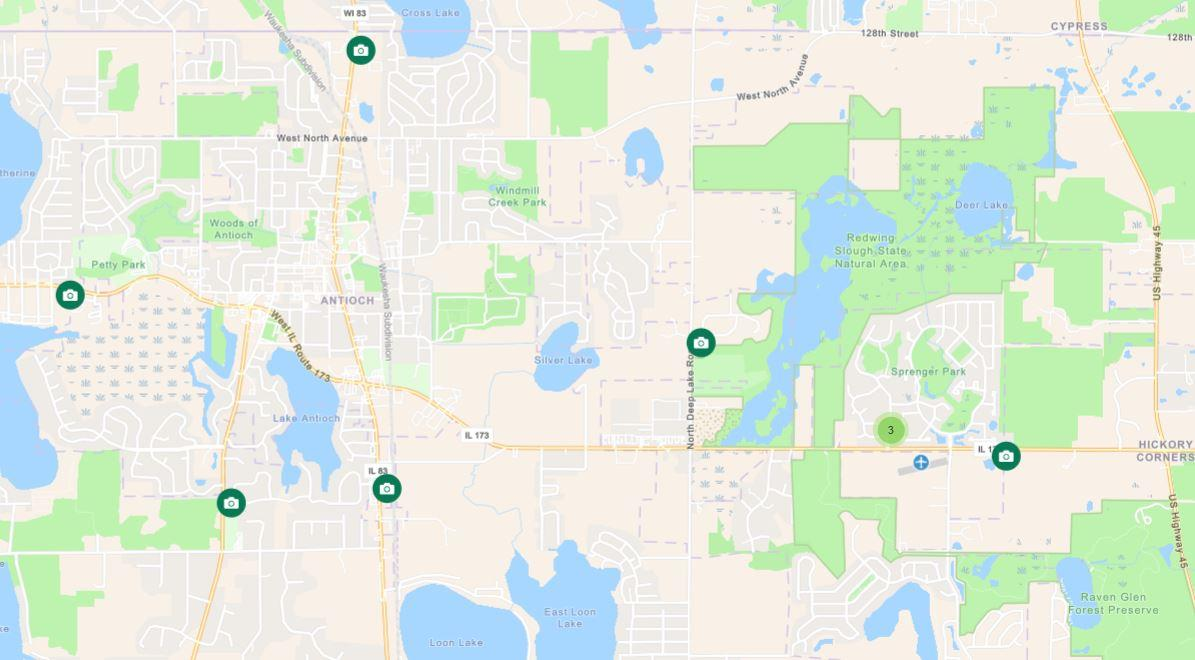
The graphic below depicts the location of Village-owned ALPR cameras. There are several private, HOA-owned ALPR cameras throughout the Village. The Antioch Police Department has access to some, but not to others.
Is ALPR information shared with other law-enforcement agencies?
The Antioch Police Department supports legitimate regional law-enforcement investigations. However, the Department has suspended direct external-agency access to data generated by Antioch’s ALPR network through the Flock portal.
Outside agencies seeking information from the Antioch network must submit a written request from a supervisor that includes:
- The requested search criteria;
- The criminal offense or offenses being investigated; and
- An active police case number.
Before an Antioch ALPR search is conducted for another agency, the request must be reviewed and approved by an Antioch Police Department Sergeant or Commander.
This process helps ensure that requests are documented, legitimate, and subject to appropriate oversight.
Can ALPR information be used for immigration enforcement or reproductive health care investigations?
No. The Antioch Police Department does not participate in civil immigration enforcement. Illinois law restricts local law-enforcement agencies from stopping, arresting, searching, detaining, or continuing to detain a person solely because of citizenship or immigration status.
Illinois law also restricts the sharing, transfer, or provision of ALPR information for the purpose of investigating or enforcing laws that interfere with a person’s lawful right to obtain reproductive health care or other lawful health care services.
How long is ALPR data retained?
ALPR data is retained in accordance with applicable Illinois law, Department policy, and the Village’s records-management requirements. Information that becomes evidence, or is reasonably expected to become evidence, in a criminal or civil matter may be preserved and maintained in accordance with applicable evidence-retention procedures.
Can an ALPR alert alone result in a traffic stop or arrest?
No. An ALPR alert is an investigative lead and does not, by itself, establish probable cause or justify enforcement action.
Before taking enforcement action, officers must evaluate and confirm the information through appropriate law-enforcement procedures, such as verifying the vehicle, license plate, and the basis for the alert.
How does the Police Department protect privacy?
The Antioch Police Department is committed to using ALPR technology responsibly and in a manner that respects privacy, civil rights, and public trust.
Safeguards include:
- Limiting access to authorized Department personnel;
- Requiring use only for legitimate law-enforcement purposes;
- Requiring documentation and accountability for ALPR searches;
- Conducting audits and supervisory review;
- Restricting external access to Antioch-generated ALPR data; and
- Enforcing Department policies and applicable Illinois and federal laws.
Unauthorized access, use, disclosure, or sharing of ALPR information is prohibited and may result in disciplinary action, criminal investigation, or other appropriate consequences.
Why does the Village use ALPR technology?
ALPR technology can help officers develop investigative leads more quickly and efficiently when a vehicle is connected to a reported crime or missing-person investigation. The system is one of several investigative tools used by the Police Department and does not replace officer judgment, follow-up investigation, or legal requirements for enforcement action.
The Village of Antioch Police Department will continue to evaluate its ALPR program, policies, and safeguards to ensure the technology supports public safety while maintaining community confidence and protecting individual privacy.
Are ALPR cameras recording video or audio?
No. ALPR cameras are designed to capture images of vehicle license plates and related vehicle characteristics, such as vehicle make, model, color, and direction of travel.
They do not record audio and are not intended to function as continuous live-video surveillance cameras.
What information is captured by an ALPR camera?
An ALPR record may include:
- A photograph of the vehicle;
- The license plate number;
- The date and time the vehicle was observed;
- The general camera location; and
- Vehicle characteristics that may assist in identifying a vehicle.
Can ALPR information be used for immigration enforcement or reproductive health care investigations?
No. The Antioch Police Department does not participate in civil immigration enforcement. Illinois law restricts local law-enforcement agencies from stopping, arresting, searching, detaining, or continuing to detain a person solely because of citizenship or immigration status.
Illinois law also restricts the sharing, transfer, or provision of ALPR information for the purpose of investigating or enforcing laws that interfere with a person’s lawful right to obtain reproductive health care or other lawful health care services.
Who can access Antioch ALPR information?
Access is limited to authorized Antioch Police Department personnel who have a legitimate law-enforcement purpose and have been granted access under Department procedures.
Searches must be conducted in accordance with Department policy, applicable law, and required documentation and audit controls.
Does the Police Department monitor people’s day-to-day travel?
No. ALPR cameras are not used to monitor residents’ routine lawful travel, identify personal associations, or create profiles of individuals.
The system is used as an investigative tool when there is a legitimate public-safety need, such as a reported crime, stolen vehicle, missing-person case, or other lawful investigation.